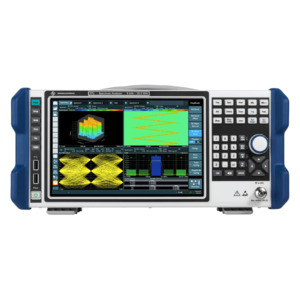

Rohde & Schwarz FPL1003 Spectrum Analyzer, Benchtop, 5kHz to 3GHz, USB/LAN, 10.1", FPL Series
Our Part #27140.1
Condition:New
Mfr Part #FPL1003
- Description
- Specifications
- Documents
Rohde & Schwarz FPL Series - FPL1003 Spectrum Analyzer
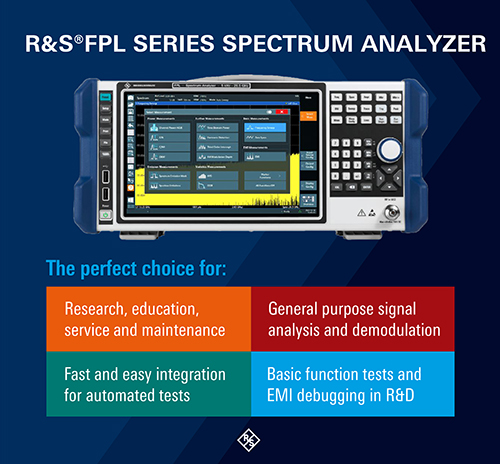
In an RF lab, the R&S FPL Series family is as indispensable as an oscilloscope or multimeter. It is a single instrument for many measurement tasks. It can be used for spectrum analysis along with highly accurate power measurements for power sensors and analysis of analog and digitally modulated signals.
Key facts (FPL1003):
Frequency range 5 kHz to 3 GHz
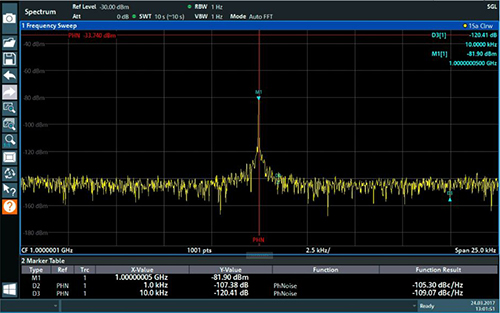
SSB phase noise: typ. –108 dBc (1 Hz) at 10 kHz
DANL with preamplifier: typ. –163 dBm from 10 MHz to 2 GHz
Lightweight with small footprint
40 MHz analysis bandwidth (option)
Your benefit | Features |
|---|---|
One instrument for multiple tasks | - Spectrum analysis - Power meter - Analog and digital signal analysis |
More space on your test bench | - Smallest footprint in its class (depth of only 23.5 cm) |
Portability | - Carrying handle and low weight - Optional battery pack forover 3 hours of operation - Optional 12 V/24 V DC power supply |
One instrument for multiple applications
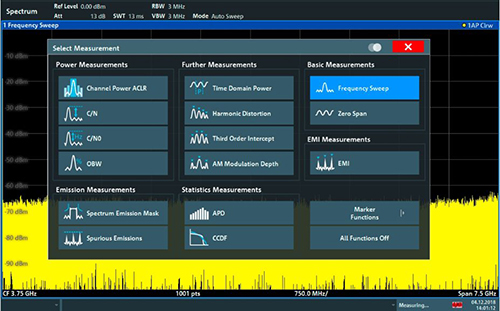
You can use the R&S FPL Series Spectrum Analyzer for spectral measurements, for highly accurate power measurements with power sensors and for analyzing analog and digitally modulated signals. The FPL Series supports the most common spectrum measurements like frequency sweep and zero span, ACLR, C/N, C/N0, OBW, harmonic distortion, TOI and many marker functions. For power measurements with power sensors, use option FPL1-K9. For analog demodulation, option FPL1-K7 is available. For the analysis of digitally modulated signals, the FPL Series can be used with the VSE Vector Signal Explorer software. which can be installed on the FPL Series or on an external PC. The options VSE-K70 (VSA) and VSE-K106 (NB-IoT) are supported with the FPL Series. When using the VSE, t he official VSE SW license with the license dongle FSPC are required. The standard analysis bandwidth is 10 MHz with optional FPL1-B40 upgrade to 40 MHz. Third party software like Matlab can extract IQ data from the IQ-analyzer. For noise figure and gain measurements with an external noise source, R&S offers option FPL1-K30.
Solid RF performance
The analog performance of the FPL Series is very close to the R&S FSV. The FPL Series features phase noise of –108 dBc (1 Hz) at 10 kHz offset (1 GHz carrier), a third-order intercept point of +20 dBm, 1 Hz to 10 MHz resolution bandwidth and –167 dBm displayed average noise level. The FPL Series has an optional pre-amplifier with 20 dB gain (option FPL1-B22) and optional 1 dB attenuator steps (FPL1-B25) to extend the usable dynamic range and sensitivity. The specified low spurious response of -70 dBc up to 10 MHz offset and even -80 dBc at higher offsets is unique in this class.
In The Box:
FPL1003 Spectrum Analyzer
Power cable
Quick start guide
R&S FPL1003 Spectrum Analyzer FAQs
1. What frequency range does the R&S FPL1003 cover?
The FPL1003 provides frequency coverage from 5 kHz to 3 GHz, making it suitable for wireless communications, IoT, RF component testing, and general spectrum analysis applications.
2. What is the maximum analysis bandwidth available on the FPL1003?
The analyzer offers a standard 10 MHz analysis bandwidth and can be upgraded to 40 MHz analysis bandwidth with the optional FPL1-B40 upgrade.
3. Can the FPL1003 perform modulation analysis?
Yes. With optional software, the FPL1003 can analyze analog and digitally modulated signals, including vector signal analysis using Rohde & Schwarz VSE software.
4. Is the FPL1003 portable?
Yes. The instrument weighs approximately 6 kg (13.2 lb) and supports an optional battery pack that provides up to three hours of operation for field measurements.
5. What applications is the FPL1003 best suited for?
The FPL1003 is commonly used for RF research, education, service and maintenance, production testing, interference hunting, and EMI troubleshooting.